
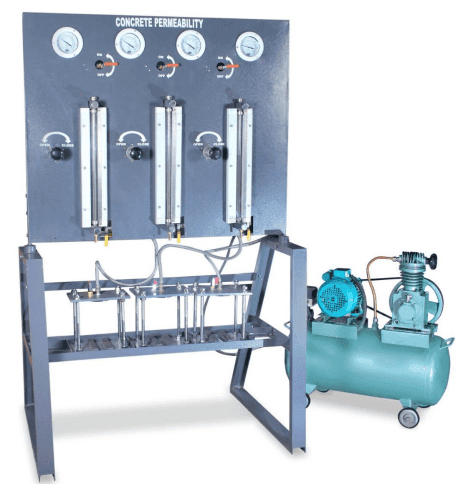
Available Variants:
- 1 Cell With Air Compressor
- 3 Cell With Air Compressor
- 3 Cell Up To 15 Kg Pressure With Air Compressor
- 3 Cell As Per IRS Concrete Bridge Code With Compressor
- 6 Cell With Air Compressor
- 6 Cell Compact
- 9 Cell With Air Compressor
Standards:
- IS 516 (Part 2/Sec1): 2018
- BS EN 12390 (Part-8)
- ISO 1920-5:2004
- ASTM C642
- DIN 1048-5
- ISO 7031
- UNI 9533
- IRS Concrete Bridge Code: 1997 (Appendix-G)
Description:
- Concrete Permeability Tester is designed to determine the depth of penetration of water into concrete under known time and pressure. The apparatus consists of specimen holder assemblies with a manifold, pressure gauges, chamber, suitable flanges and gaskets. Concrete specimens are placed in the test chamber and subjected to controlled water pressure for the prescribed duration. After testing, the specimen is split and the depth of water penetration is measured.
- The apparatus is supplied with an air compressor where specified. The equipment accommodates concrete cylinder specimens of 150 mm diameter × 160 mm high or cube moulds of 150 × 150 × 150 mm dimensions. The Compact variant also supports cubic, cylindrical or prismatic specimens up to 200 × 200 × 200 mm.
Applications:
- Water penetration testing of concrete to determine the depth of water penetration and assess concrete impermeability under known time and pressure.
- The 3 Cell variant applies a water pressure of 500 ± 50 kPa to a concrete specimen for 72 ± 2 hours, after which the specimen is split and the maximum penetration depth is measured.
- The IRS Concrete Bridge Code variant is used for permeability testing as per IRS Concrete Bridge Code 1997, Appendix-G.
Apparatus Details:
- The standard Concrete Permeability Tester consists of specimen holder assemblies, manifold assembly, pressure gauges, chamber and suitable clamping arrangements.
- The specimen is placed into the test chamber and clamped with suitable flanges and gaskets. Known water pressure is applied to the specimen surface for the prescribed time using a suitable air compressor. The penetrated water is measured by splitting the specimen.
- The standard specimen size for the applicable variants is 150 mm diameter × 160 mm high or 150 × 150 × 150 mm cube.
- The Compact variant consists of a chamber with quick clamping arrangement and special circular gaskets. It is equipped with stainless steel 304 grade specimen holders, air and water pressure gauges, brass water valves, sealing rings and a stainless steel platform with drainage arrangement. It can apply and maintain up to 7 kg/cm² pressure for up to 72 hours.
- The IRS variant consists of permeability cells, water reservoir, graduated side arm gauge-glass, fittings and valves for admitting water and compressed air, draining, bleeding and connecting to the permeability cell.
Variant Details:
1 Cell With Air Compressor:
- Concrete Permeability Apparatus consists of a single specimen holder assembly as per IS 516 (Part 2/Sec1): 2018.
- Fitted with manifold assembly to hold end pressure of maximum 7 kg/cm², chamber pressure gauge of 14 kg/cm² and another pressure gauge of 21 kg/cm² to show the inlet pressure.
- Supplied complete with Air Compressor.
3 Cell With Air Compressor:
- Concrete Permeability Apparatus consists of three specimen holder assemblies as per IS 516 (Part 2/Sec1): 2018.
- Fitted with manifold assembly to hold end pressure gauge of 14 kg/cm² (14 Bar), chamber pressure gauge of 21 kg/cm² (21 Bar), with another pressure gauge of 14 kg/cm² (14 Bar) on the chamber to show the inlet pressure.
- Supplied complete with Air Compressor.
3 Cell Up To 15 Kg Pressure With Air Compressor:
- Concrete Permeability Apparatus consists of three specimen holder assemblies as per IS 516 (Part 2/Sec1).
- Fitted with manifold assembly to hold end pressure of 15 kg/cm² (15 Bar), pressure gauge of 21 kg/cm² (21 Bar) and another gauge of 21 kg/cm² (21 Bar) on the panel to show inlet pressure.
- Size: 150 mm diameter × 160 mm high.
- Complete with Air Compressor.
- Includes 3 HP High Pressure Air Compressor With 50 Litre Tank.
6 Cell With Air Compressor:
- Concrete Permeability Apparatus consists of six specimen holder assemblies as per IS 516 (Part 2/Sec1): 2018.
- Fitted with manifold assembly to hold end pressure of maximum 7 kg/cm², chamber pressure gauge of 14 kg/cm² and another pressure gauge of 21 kg/cm² to show the inlet pressure.
- Supplied complete with Air Compressor.
6 Cell Compact:
- Concrete Impermeability Apparatus consists of a chamber where the concrete sample is placed and pressure is applied to force water or other fluids through the concrete.
- Supports six specimen holders accommodating 150 mm cube or cylindrical specimens.
- Constructed from premium-grade materials for enhanced durability. Stainless steel 304 grade specimen holders resist corrosion and maintain structural integrity.
- Fitted with high-quality air and water pressure gauges for precise readings and brass water valves for smooth operation.
- Capable of applying and maintaining up to 7 kg/cm² pressure for up to 72 hours.
- Designed to apply water pressure from the bottom of the specimen.
- Each specimen holder features a single spindle for easy tightening or loosening of the specimen.
- Sealing rings are provided at the bottom of each holder to prevent water leakage.
- Specimen holders are mounted on a stainless steel platform to collect dripped water.
- The platform includes a drainage system with a hole and drain pipe for easy water removal.
9 Cell With Air Compressor:
- Concrete Permeability Apparatus consists of nine specimen holder assemblies as per IS 516 (Part 2/Sec1): 2018.
- Fitted with manifold assembly to hold end pressure of maximum 7 kg/cm², chamber pressure gauge of 14 kg/cm² and another pressure gauge of 21 kg/cm² to show the inlet pressure.
- Supplied complete with Air Compressor.
3 Cell As Per IRS Concrete Bridge Code With Compressor:
The apparatus consists of 3 permeability cells.
- Each permeability cell consists of a non-corrodible metal cylinder for holding a specimen of 200 mm diameter × 120 mm high. A rubber or neoprene O-ring or other suitable gasket, seated in matching grooves, is used between the cell and cover plate to render the joint water-tight.
- The water reservoir consists of a suitable metal pipe, 50 to 100 mm diameter and about 500 mm long. It is fitted with a graduated side arm gauge-glass and necessary fittings and valves for admitting water and compressed air, draining, bleeding and connection to the permeability cell.
- Test specimen of 200 mm diameter and 120 mm thick is used. After 24 hours of casting, the central circular area of 100 mm diameter is roughened with a wire brush on the side where water pressure is applied. The unroughened part is sealed with two coats of cement water paste with W/C = 0.4.
- After 28 days curing, the specimen is fitted into the test apparatus. Pressure of 1 Bar is applied for 48 hours, followed by 3 Bar for 24 hours and 7 Bar for 24 hours through an Air Compressor.
- After testing, the specimen is split in the middle by compression applied on two round steel bars lying on opposite sides.
- The average of three maximum values of penetration is calculated. The depth of penetration of water should not be more than 25 mm; otherwise, the specimen is considered failed in the permeability test.
- Consumable available at extra cost: Sealing compound, wax and resin.